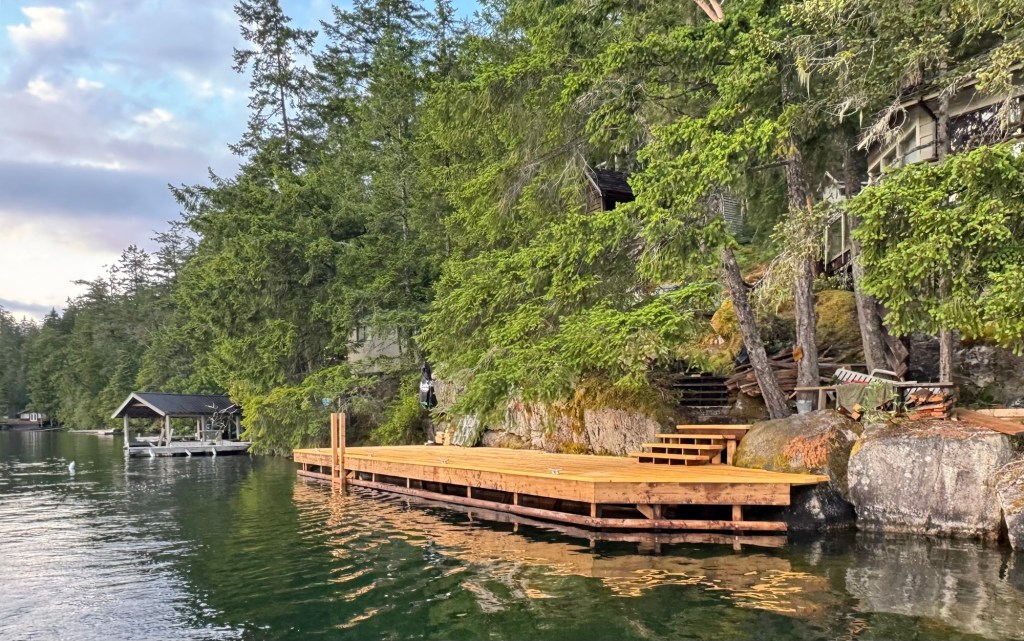
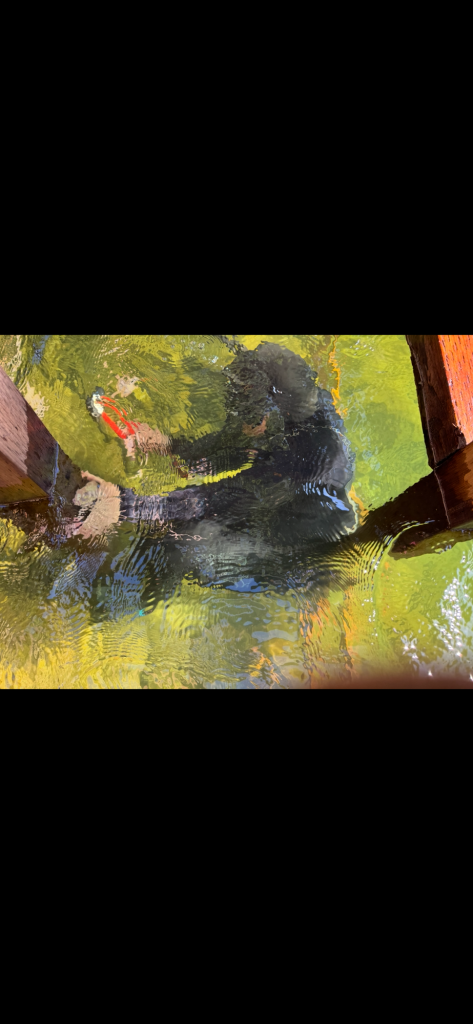
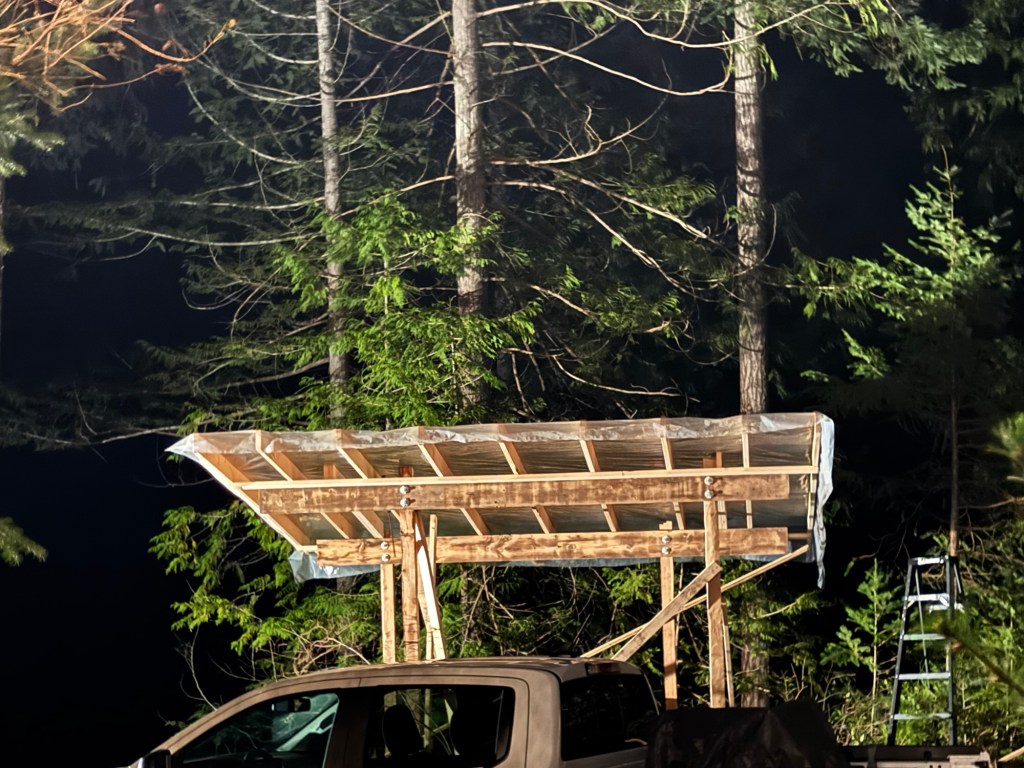
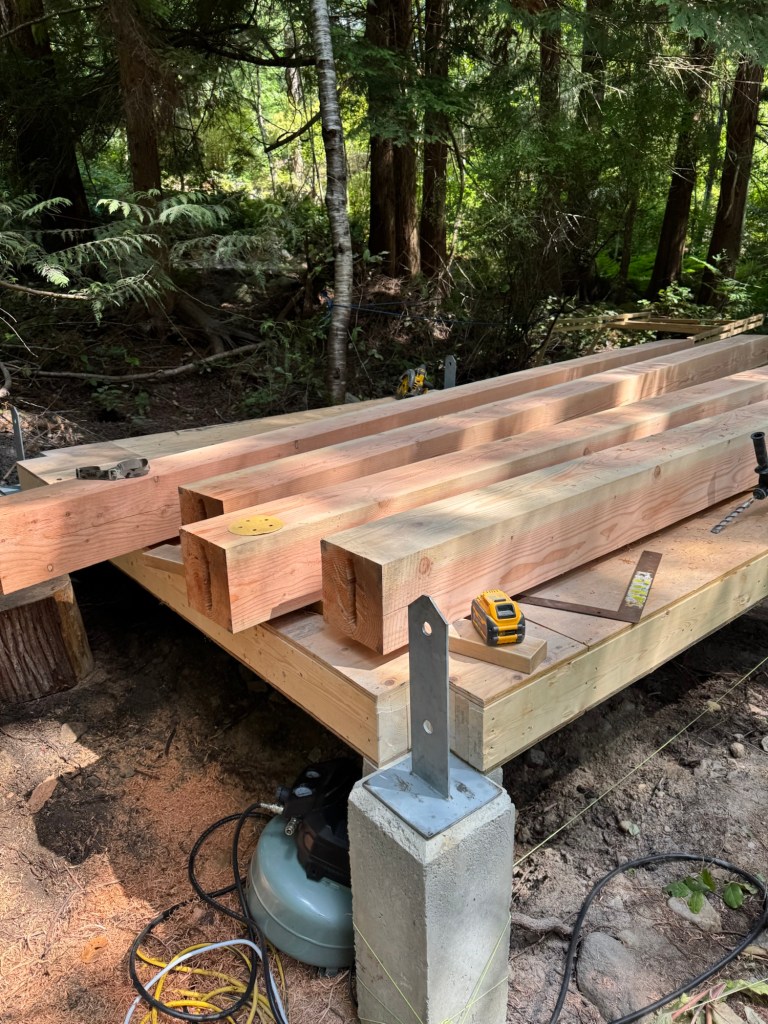
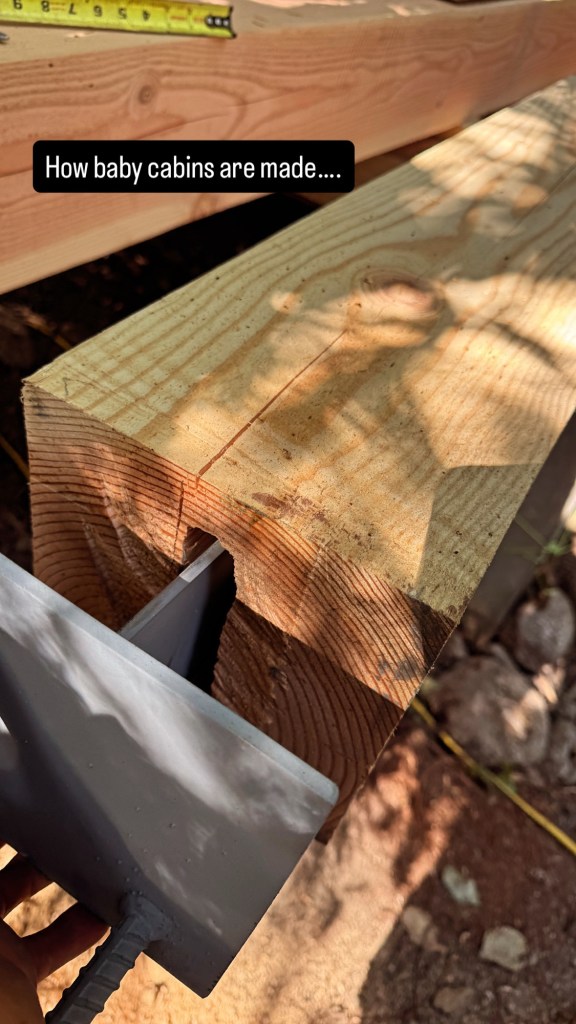
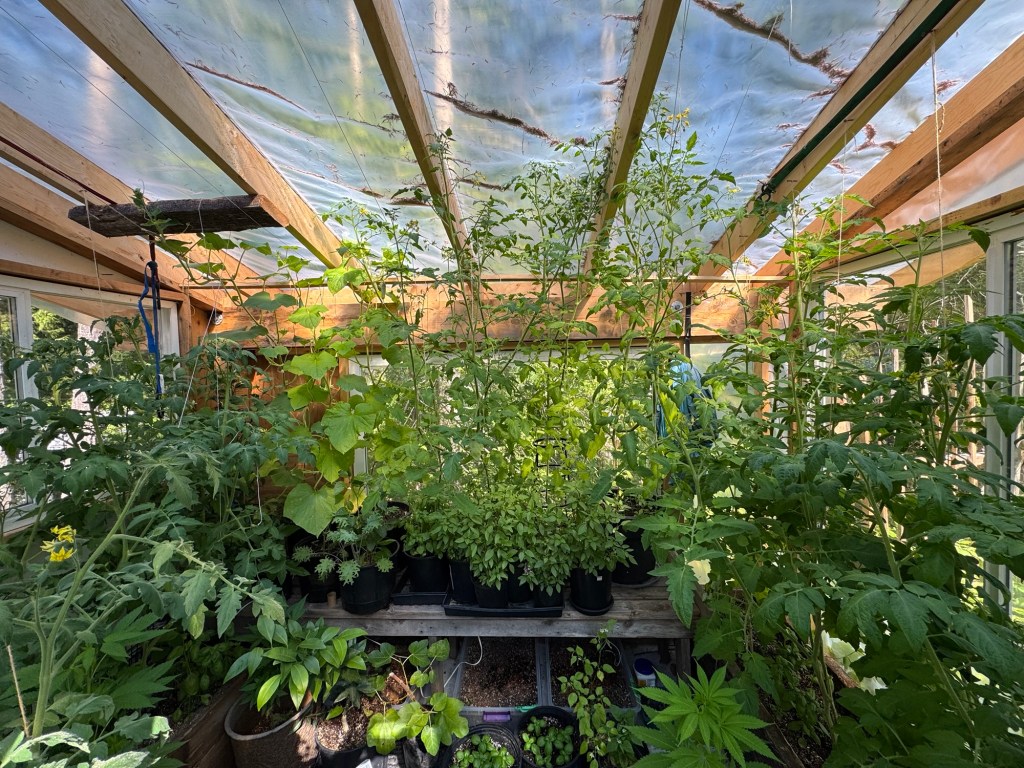
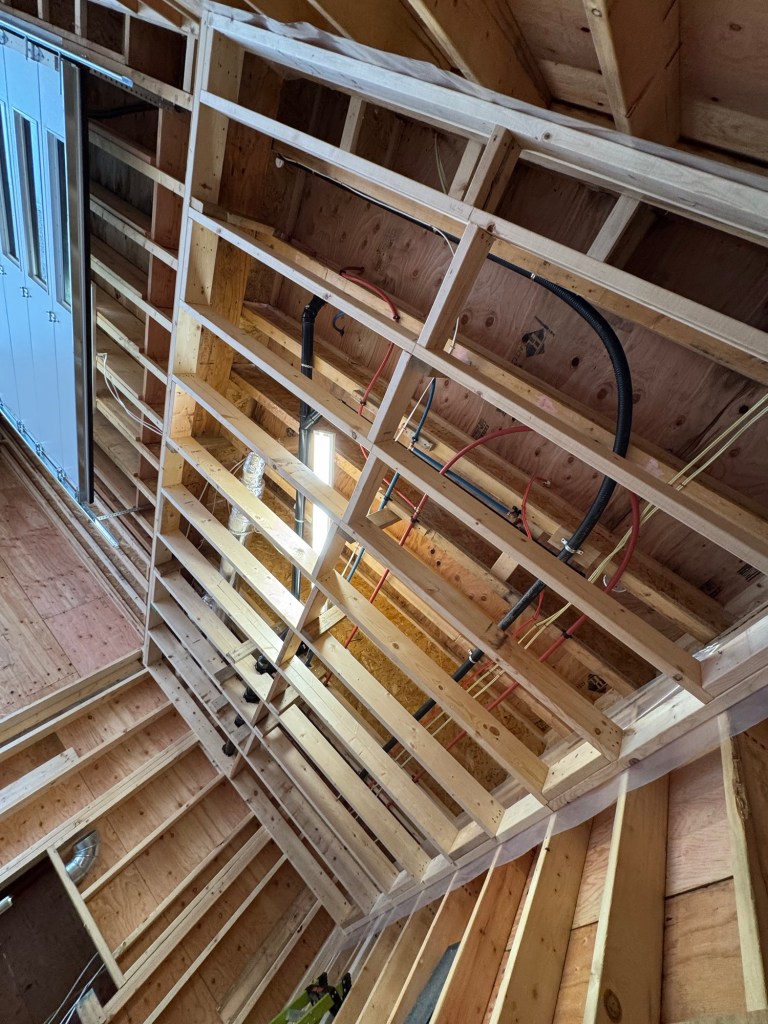
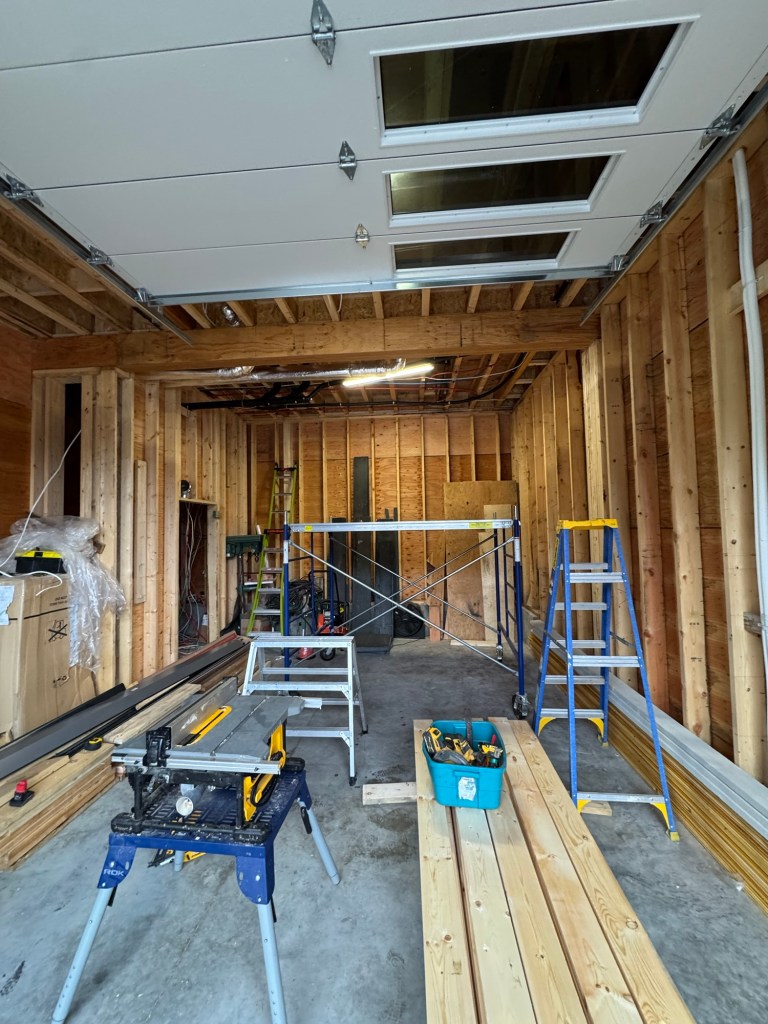
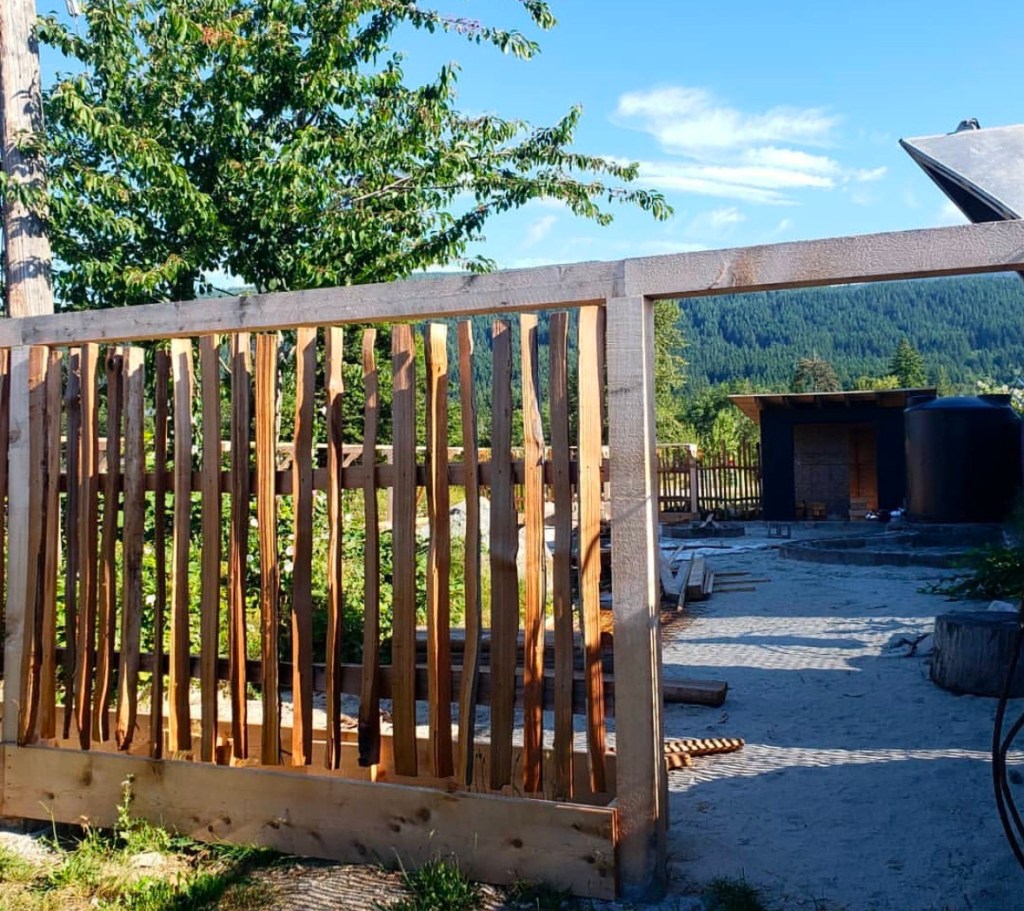
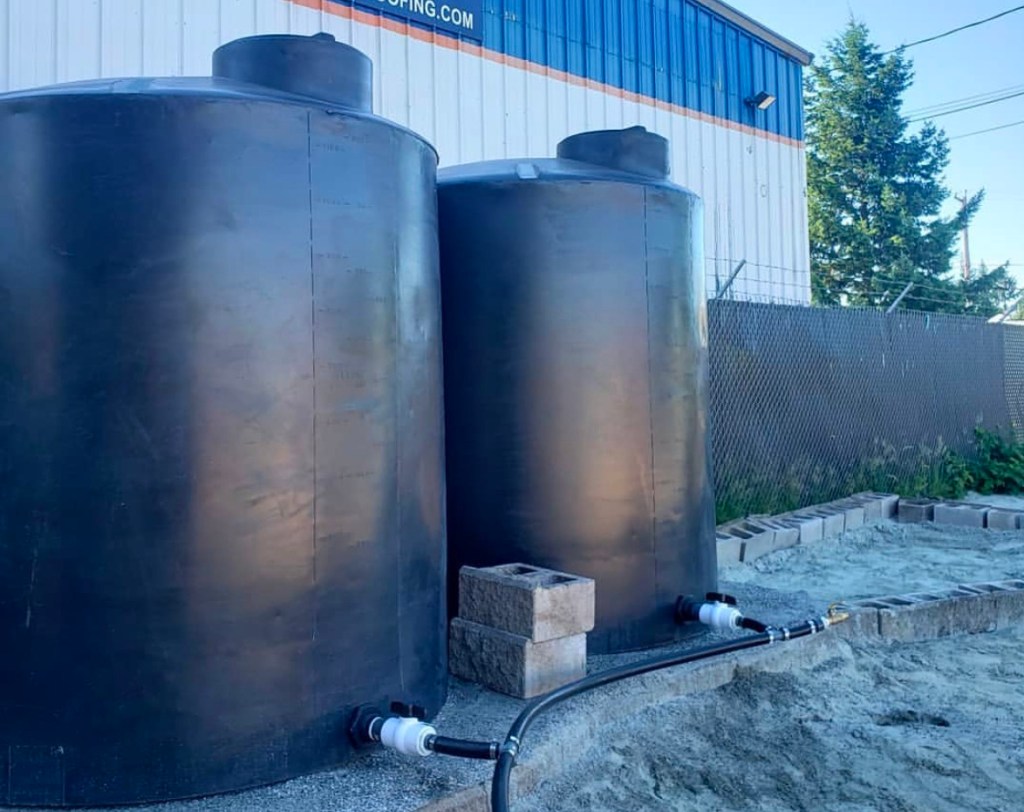
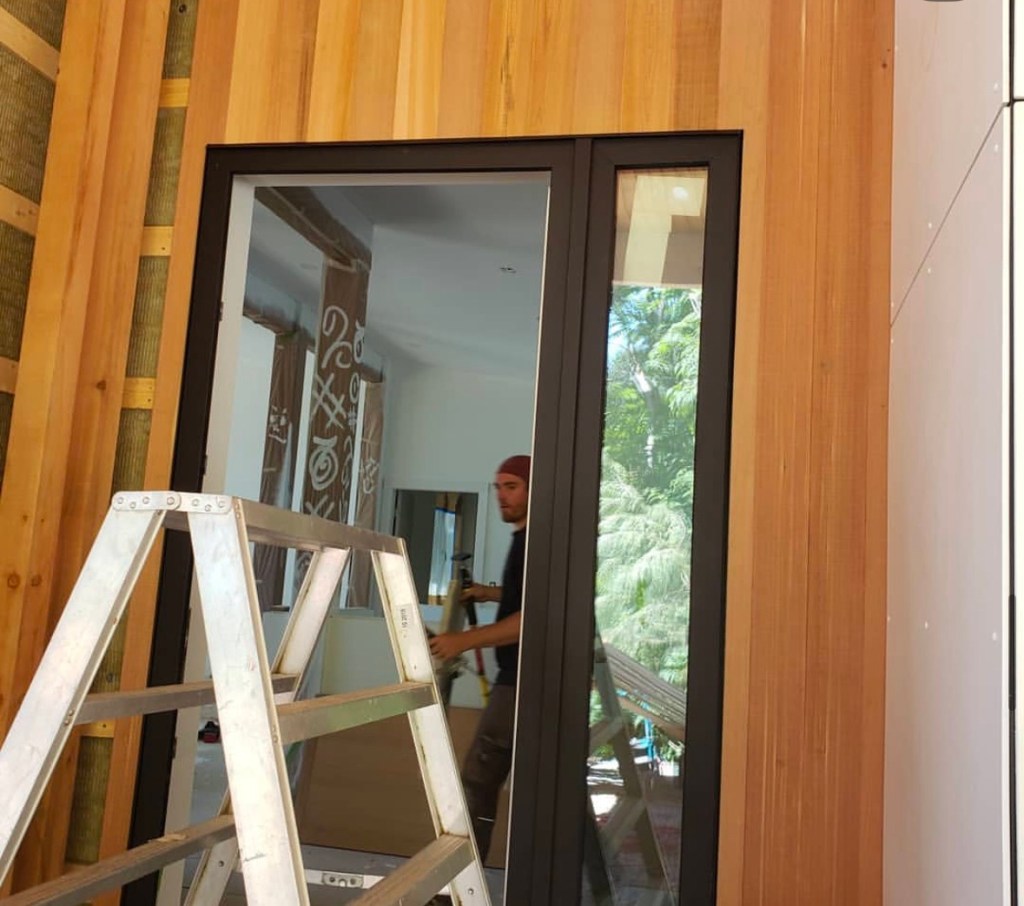
We’ve been busy with all sorts of work this year. We started out the calendar year helping Coast Summit Services to finish up a Renovation on Sakinaw, we’ve repaired 2 docks; we’ve also: formed up hot-tub pad on bedrock in secret cove and some cedar/aeroplane cable handrails to accompany it, done cabinetry and big timber furniture with Coast Sumit in the workshop that ended up on a private island in The Sechelt Inlet, we’ve built a greenhouse out of reclaimed lumber, completed a couple of drop ceilings, some back framing and deficiencies for a home owner builder, and recently made a solid start on a post and beam bunky.
While there’s still lots of work in the pipeline we are also looking to diversify our clientele, hoping to form long term working relationships.
Get your lists ready so we can schedule you in for this fall and winter.
Charlie began his framing apprenticeship with Brian Giampa with a project under Natural Balance Homes. He finished his apprenticeship with Summerhill Fine Homes.
He completed the Interpersonal Red Seal with BCIT in 2021.
He’s competent with high end finishes, passive house principles, and energy efficient construction.
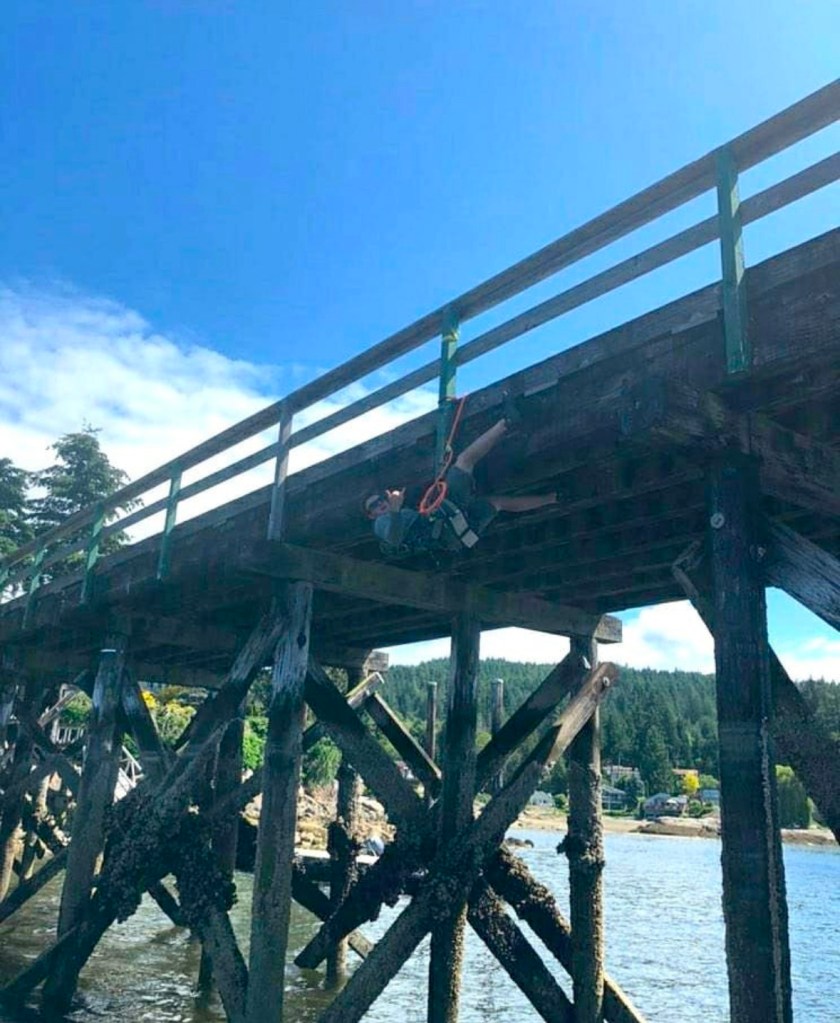
Off grid and ocean access qualified: He assisted with the development of a 125 Acre Wilderness resort on a water access only property in The Sechelt Inlet In 2014/2015. He also worked at Box Canyon Hydro Facility in Howe Sound, doing routine maintenance on the roads, powerhouse, turbine and also built small dams to adjust water flows. For several years he co-managed an Inspection and maintenance contract with the SCRD’s 9 docks in Howe Sound, Halfmoom Bay and Thormanby. He holds an SVOP (small vessel commercial captains licence) and knows the majority of the waters from Vancouver to Sanora Island, with Howe sound, Sechelt Inlet, Jervis Inlet and Nelson/Hardy Island being very familiar.
He’s more enthusiastic than your average carpenter with regard to native and edible landscaping, outdoor kitchens, baths, showers, hot-tubs, decks and privacy screens. He’s passionate about the type of home and land improvements that invoke us to live better, longer, and be more connected with nature.
He is competent in basic machine operation, mini excavator, skid steer etc.
He has skilled help available to assist with bigger jobs as well as great working relationship with Strait Timber Saw Mill, and any and all sub-trades.
It could be a fire pit nexto a lean-to and outdoor kitchen that makes meeting with your friends on Fridays so easy that the routine never fades of fizzles.
It could be an outdoor bathtub so that each night after the sun goes down you can come soak in the luxury of your ‘home made hot spring’ soaking under the stars without the chemicals, hum of any pump, or lights that would dampen the senses of the night.
It could also be a yoga or art studio, or work space that faces the ocean, that doubles as somewhere you go to read or work on things which benefit from your uninterrupted presence. A place where you can banish your cell phone for a time, and give yourself fully to enjoying the reflected sunset, admiring the way the reflected light hits the underside of the reclaimed beams and decking.
It could just be creative ways to use fallen trees, or off cuts, and turn them in to functional pieces for your outdoor living spaces such as benches, arbours, gates or fences.
Regenerative Developments is here to match and stoke your passion for your projects. We want to help you to design and build spaces that help you to thrive.
We look forward to hearing about your dreams, and visions for your properties.
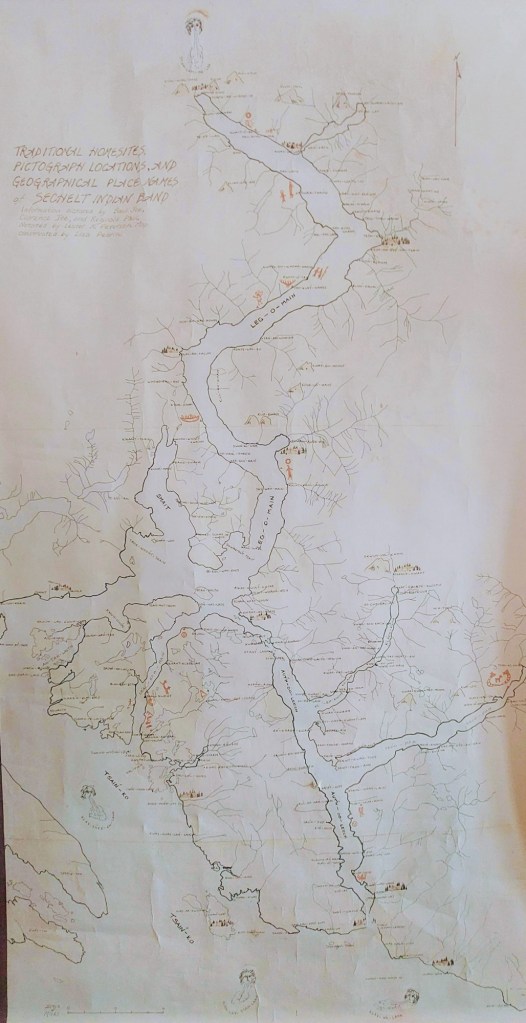
It’s been said by some that the indigenous of the Pacific Northwest developed some of the most complex non agricultural societies on the planet, and it’s hypothesized that this can be largely attributed to the natural abundance of the region, as well as through their advance systems of regenerative land management, and intertidal zone stewardship.
A Map Shared by Calvin Craigan aka Hiwus of the indigenous place names of the region.
While the most plentiful natural food resource around here realistically come from animals in the form of oceanic and land mammals, as well as salmon; herring; eulachon, lingcod, rock cod, kelp greenling, crabs, oysters and clams etc; plant foods and medicines of the lands complete this seemingly perfect diet.
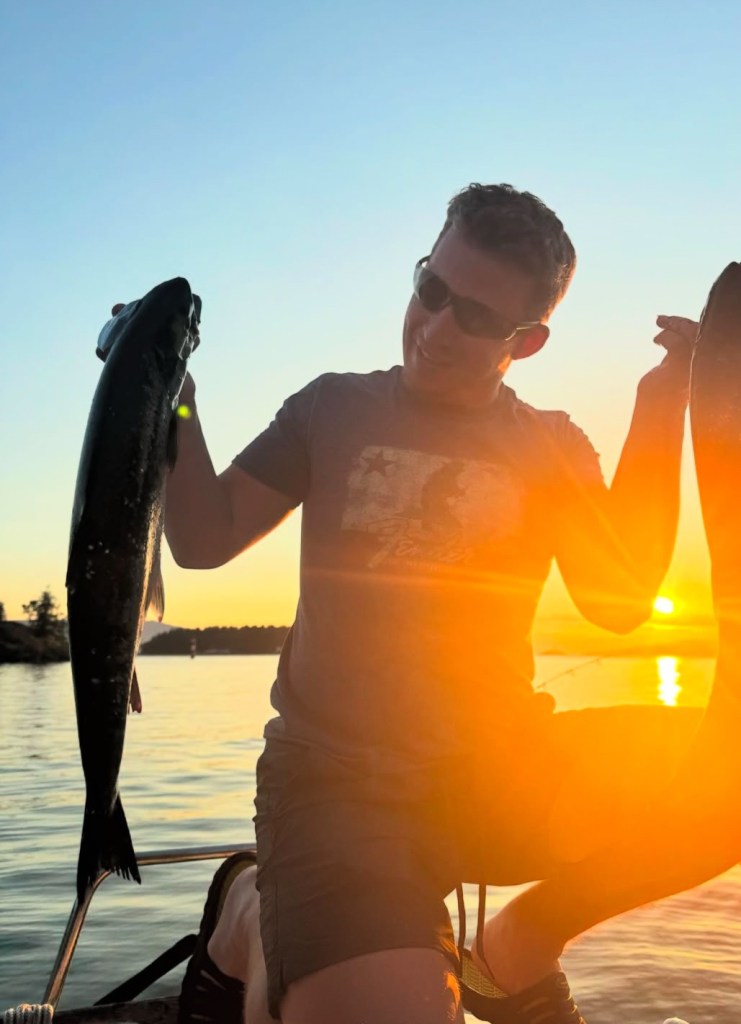
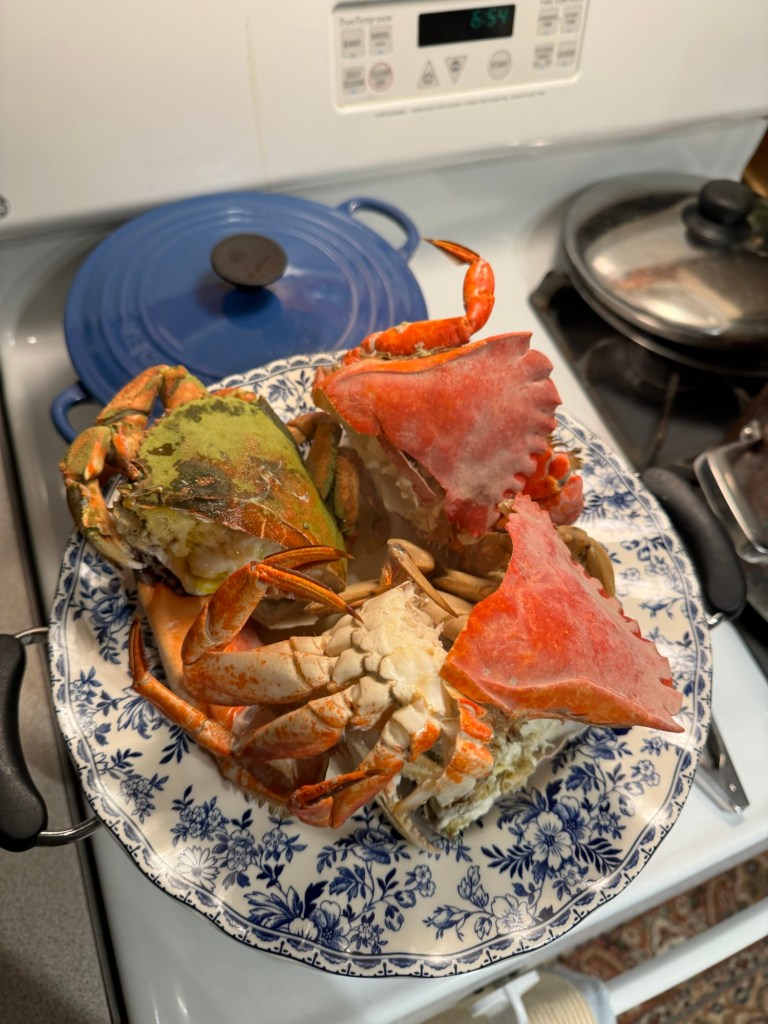
Friend, Welder, and first ever Help for a Regenerative Development project back in 2018, Lindsay Johnstone here showing off a couple of coho caught on their way to spawn up river and share their pelagic nutrients with the forest ecosystem. ‘We are not working with nature, we are nature, working’.A Red Rock Crab caught using a trap near Pender Harbour, and A Dungeness Crab Caught By Hand in Davis Bay later that day.
This article aims to be a simplified overview of some of the common and useful plants in the local ecosystem and also talk about a few of their non native cousins, within their plant families that easily thrive here in our gardens, and provide us with nutrition, medicine and many other uses.
First thing to note about this area is the physical geography. The ground its self is fairly void of topsoil. Glaciation carved away most of soil all the way to granite bedrock during the last ice age. Secondly, the heavy rains that mostly fall in the winter months further leach nutrients away from the thin soil layer, and since they fall in the dormant season for plants, they don’t help as much as we’d like with plant growth. Some people are curious to learn that in much of the region most of the tree growth actually occurs in the spring and fall, and the trees go somewhat dormant both in winter but also mid summer when water is scarce.
The big U shaped valley Fjord of Princess Louisa inlet, a telltale giveaway of its glacial history. Also note James Bruce Falls in the back, technically N.Americas tallest waterfall, fed all year by the glacia and snow pack above.
Due to a lack of typical summer rains and topsoil, the thick deciduous dominant forests that would be found in similar latitudes elsewhere in the world like Western Europe or North America’s East Coast, don’t fair well here. Instead it is the drought tolerant conifers that dominate.
The summer droughts here play a huge factor in why conventional agriculture doesn’t thrive here without irrigation, and perhaps a factor why annual agriculture wasn’t really developed here in the same way as it was in Western Europe, the Fertile Crescent, Central America and Parts of Asia approximately 12,000 years ago.
Despite the lack of soil and summer rain, the natural flora and fauna provides an astounding abundance of food and nutrition to those that know what to look for. The indigenous of this region have managed this ecosystem, farming in their own way, by favouring more abundant food producing systems for at least as long as annual agriculture and animal husbandry had been practiced elsewhere in the world, and some say, for significantly longer. This region is ideal for developing food forest/food Savanah style systems.
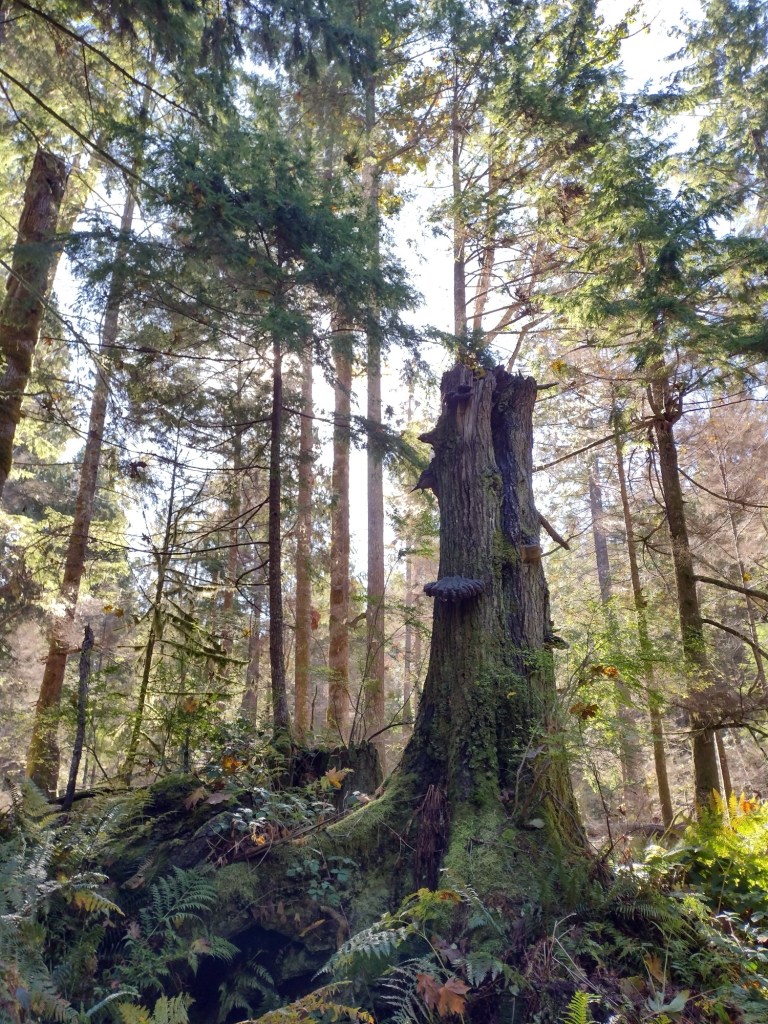
The climax community (The ecosystem arrived at over time; if there is no disruption, whether that be by Fire, floods, landslides, or intervention by humans) here consists mostly of an over-story of Douglas fir (Pinaceae Pseudotsuga menziesii)), Western Red Cedar (Cupressaceae Thuja Plicata), and Western Hemlock (Pinaceae Tsuga heterophylla) with an understory of Sword Ferns (Dryopteridaceae Polystichum munitum), Salal (Ericaceae Gaultheria shallon), Oregon Grape (Berberidaceae Berberis aquifolium) and Red Huckleberry (Ericacae Vaccinium parvifolium), and of course an abundance of seasonal mushrooms under that in the fall.
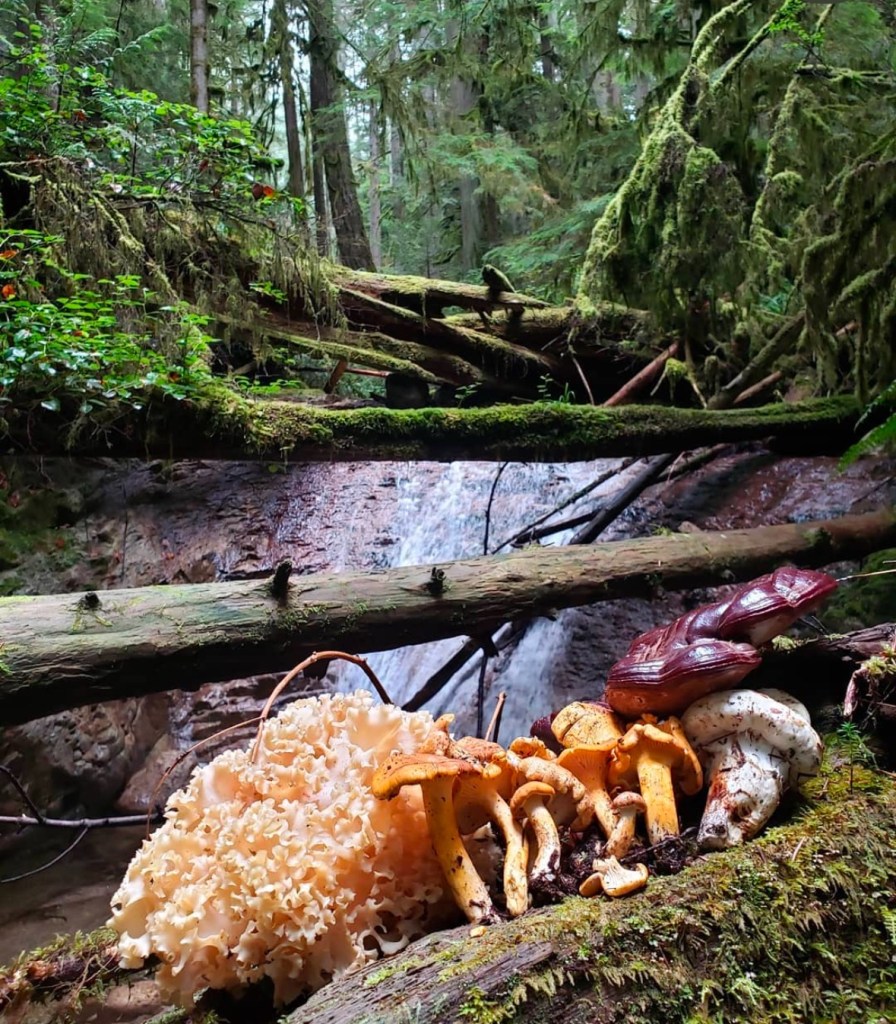
A spread of gourmet and medical mushrooms picked in a second growth forest on The Coast
The edge and succession ecosystem are the part of the ecosystem that is either found at the edges where a forest meets a body of water, a meadow, or a disturbance such as a landslide. Most often of course today it’s where a forest meets a manmade disturbance such as a clear-cut or a road. After disturbance, succession begins with pioneer species that grow in and start the process of turning what might be a gravel landslide, or bare earth and begin the process of building soil for plants further along in succession (on a journey back towards the climax community)
Red Alder (Betulaceae Alnus rubra) with it’s symbiotic relationship with bacteria housed within it’s root system is a potent nitrogen fixer. It helps to lay the foundation for prosperity for all plants that come after it. Interestingly, nitrogen, or lack of it, can often be the limiting factor in tree growth at times of year when water is abundant and there is sufficient sunshine. So much so, that in some situations, good salmon years can be identified in tree rings, because the salmon carcasses which are high in nitrogen are spread by animals, and then further by mycelium, and it results in greater tree growth in those years.
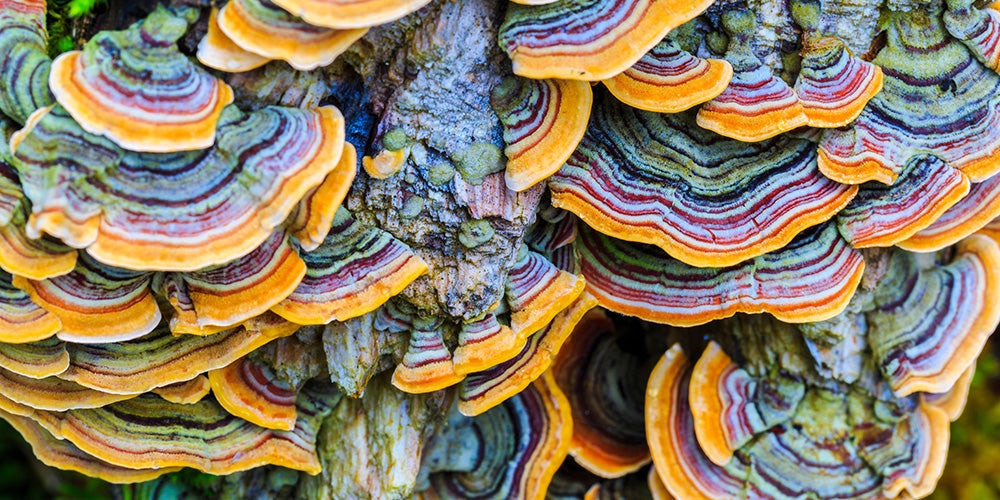
At the end of its life, Alder, with its high sugar content also becomes great food for mycelium, specifically edible oyster mushrooms (Pleurotus pulmonarius) and medicinal turkey tail mushrooms (Trametes versicolor)
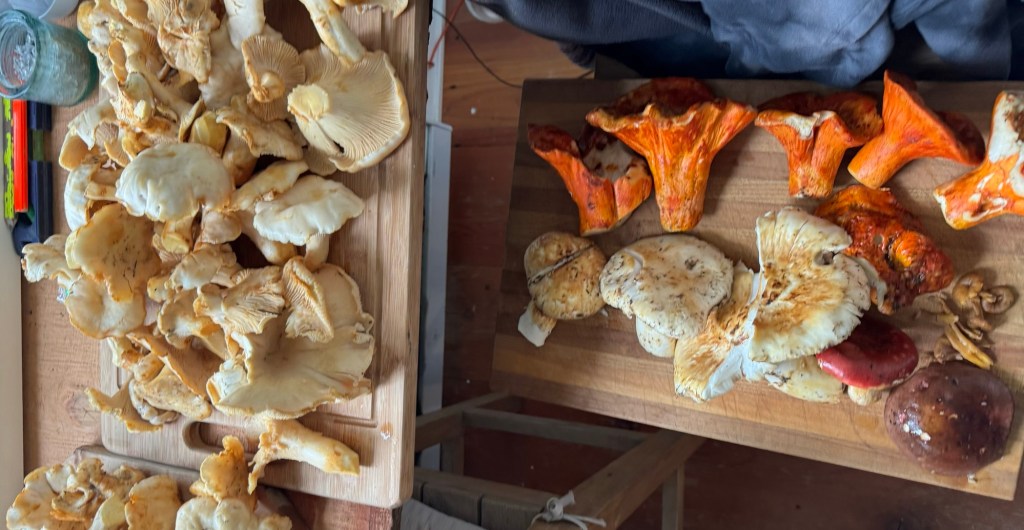
Clockwise from top left: Oyster Mushrooms Growing on Alder, Pscilocybe Cyanscens Growing on Alder Duff, Shrimp Rusulas, Lobster Mushrooms and Pine Mushrooms found on the climax community’s forest floor.Medicinal Turkeytail Mushrooms growing on Alder (appropriately named Trametes Versicolor (Varied-colour, due to the facet its colours vary significantly depending on the substrate it grows on))
Other succession and edge species include various Maples (Tree from the Sapindacae/Soapberry family and Acer Genus), Gary Oaks (Fagaceae Quercus garryana), Chokecherry (Rosaceae Prunus virginiana), Hazelnut (Betulacea Corylus cornuta), Elderberry (Adoxaceae Sambucus Racemosa), Salmonberry (Rosaceae Rubus spectabilis), Thimbleberry (Rosaceae Rubus parviflorus) and wild blackberries the native variety being the trailing blackberry (Rosacae Rubus ursinus), Wild Blackcurrants (Grossulariaceae Ribes americanum) and Wild Strawberries (Rosacae Fragaria vesca).
Wild Blueberry growing at the base of Chatterbox FallsSalmon Berry also in Princess Louisa InletA Nootka Rose, growing just above the high tide line near (James F. MacDonald’s home site, the former unofficial steward of Princess Louisa Inlet, which is also a sacred site to the Sechelt Band)A Maple Snag with huge medicinal Reishi Polypore growing on Gambier Island in Howe Sound (Ganoderma oregonense)
Many edges and medow ecosystems, specifically the low altitude meadow ecosystems were intentionally maintained by controlled burns and (in some places the practice is being reestablished, since much of these practices were lost in the era of residential schools), this practice promotes grasses, that encourage deer to come out in to the open to graze, which makes for easy hunting, aswell as creating ideal conditions for edible tubas such as Blue Camas (Asparagaceae Camassia qua-mash). These meadows also tend to be full of flowers throughout the spring and summer.
If we also include the coastal ecosystem, we can’t forget Arbutis (Ericaceae Arbutus menziesii), Crab Apple (Rosacea Malus fusca) and Nootka Rose (Rosacea Rosa nutkana), and if we include the subalpine we then have mountain huckleberries (Ericacea Vaccinium membranaceum) and countless other flowering plants.
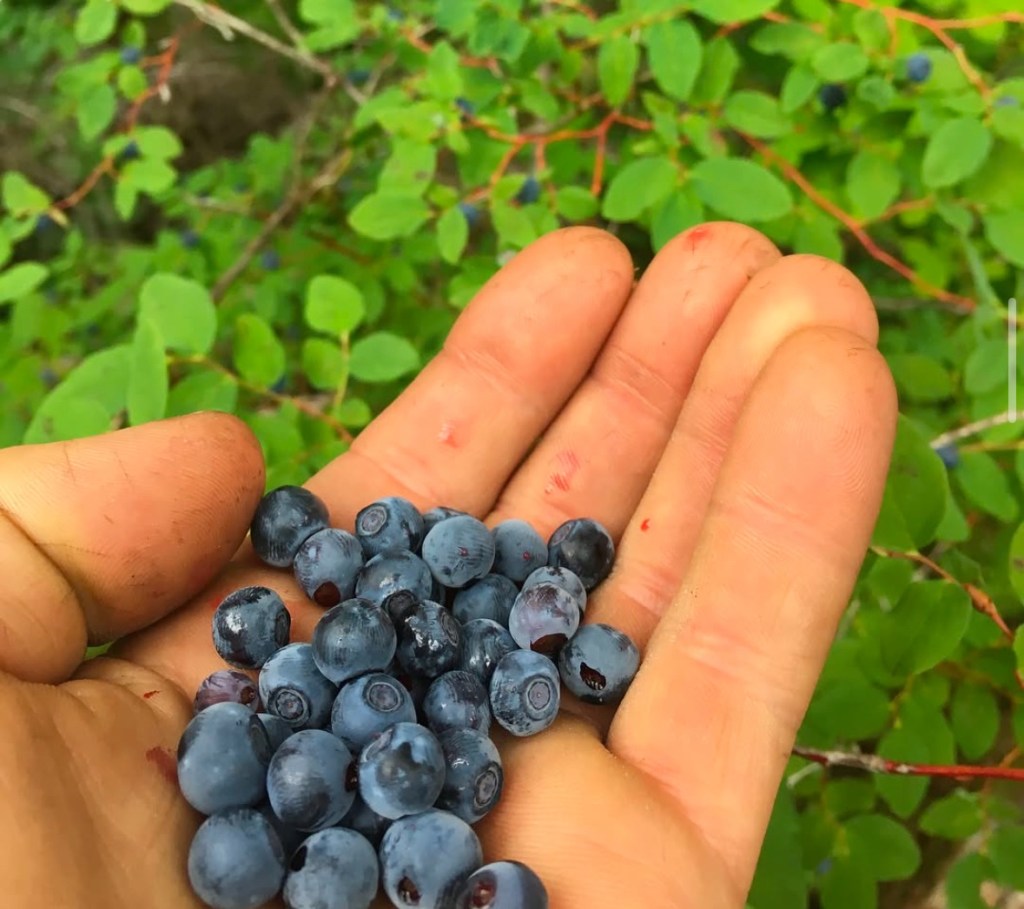
Mountain Scenes from Mr HallowellWild Bluberries/Mountain Huckleberries (Vaccinium membranaceum)
It truly is incredible that the majority of the common plants that grow here have at least edible parts to them at certain times of the year, and so the basics of a nutritious and interactive landscape can start simply by acknowledging and supporting what is already growing here without any human intervention.
When we broaden the diversity of our landscapes around our home and start to include all of the above, regardless of the elevation and proximity to the ocean of our specific property, we already have a phenomenal food producing garden. When we start to add in some not so distant cousins to these native plants we quickly set the stage for abundance in the nutrition department. We can bring in raspberries where salmon berries thrive, and apples where crab apples thrive and all different types of prunus species such as plums and apricots where chokecherries effortlessly grow.
Of course, as we get more ‘exotic’ we do also begin to become more of a target to deer and so fencing becomes essential and irrigation preferred, but still a fairly easy garden to grow and maintain.
With irrigation we can also have the traditional raised bed gardens to grow our carrots and potatoes, salad greens, and flowers, but even these gardens can benefit from the microclimates created by the some tall trees for dappled shade at high noon. We can also mimic the coolness and humidity of forests by vining over a trellis where we want to grow our delicate greens that are prone to bolting in high heat.
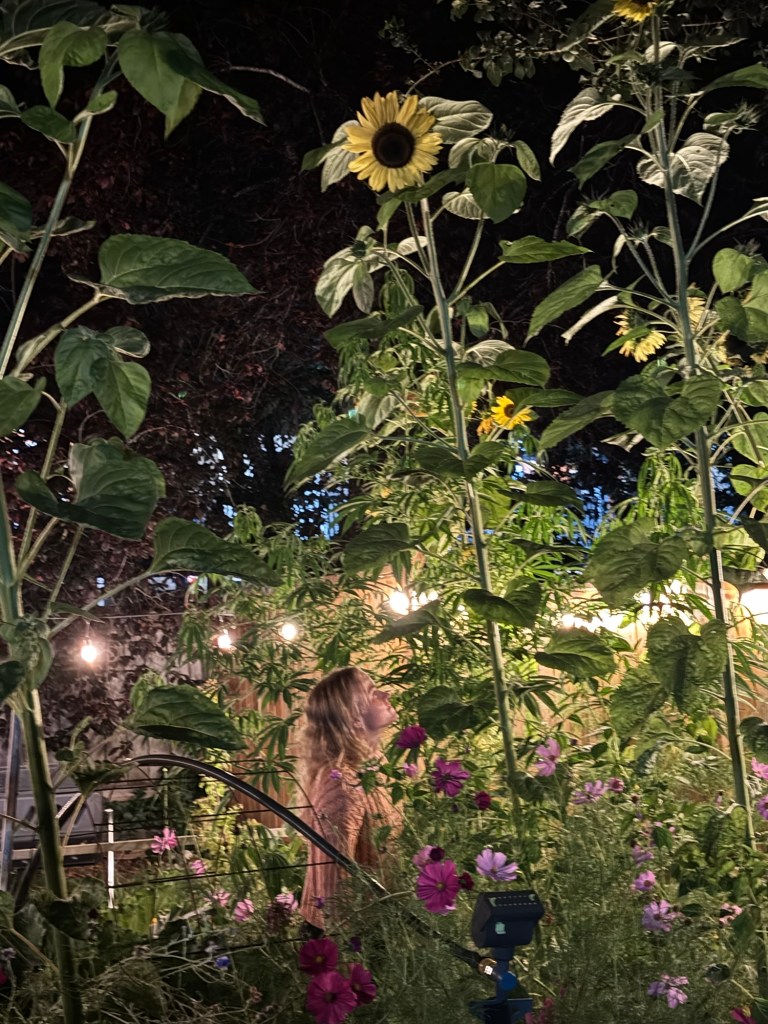
What a garden can look like with a bit of irrigation and evening ambient lighting
Nearly every plant mentioned above, has several uses. For example D.Fir (Pseudotsuga menziesii) is the most sought after structural softwood on the planet, it has an edible cambium, the green pinecones can be added to a jar with sugar which will draw out the moisture creating a delicious pine syrup which is very similar in use and in flavour to maple syrup, the pine needles themselves are packed with vitamin C and make a great tea. It also has useful cousins that can be grown here which are grown commercially elsewhere for pine nuts. These include Korean pine (Pinus koraiensis) grown commercially in east Asia Siberian pine (P. sibirica) grown commercially in Russia and Stone pine (P. pinea) grown commercially in Europe.
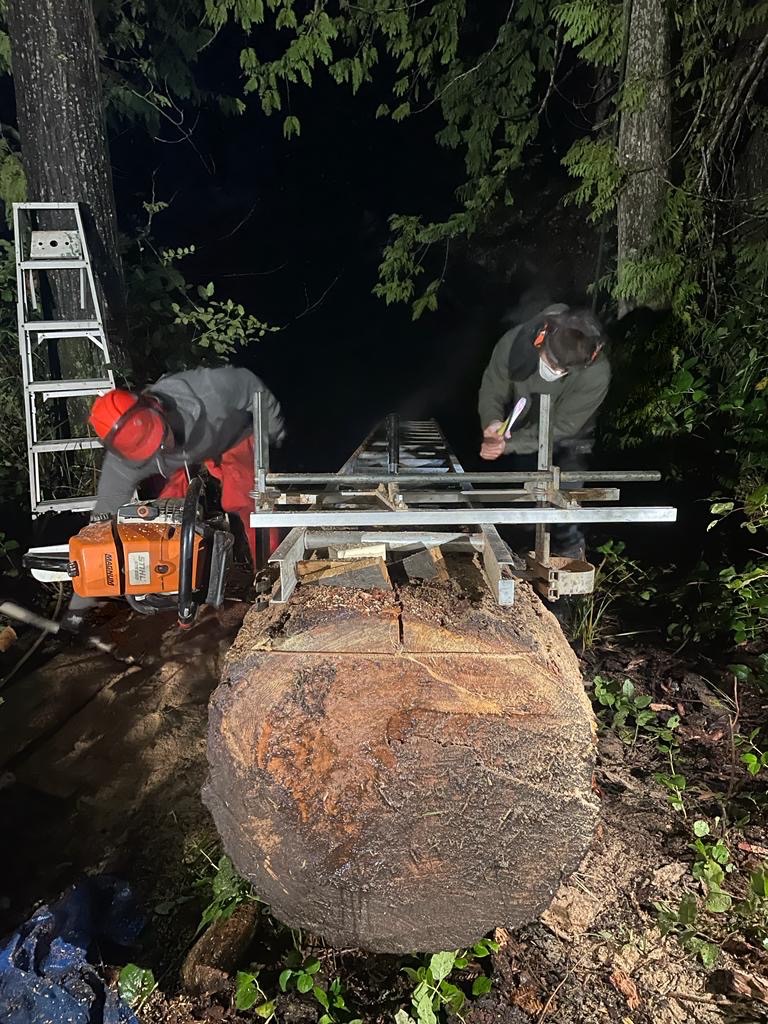
Chainsaw Milling Oldgrowth Windfall D.Fir (Pseudotsuga menziesii) on a friend’s property in hopes that it can live another life, housing visitors to this beautiful region.
As gardeners we might also be interested to look at similar plants that come from analogue climates, places in the world with similar climates. For example, The Monkey Puzzle (Araucariaceae Araucaria araucana) of southern Chile and Western Argentina, which although taking 30 years to mature will eventually provide massive pine nuts that fall to the floor for easy harvesting.
Bringing it back locally though, two families seem to stand out as being seemingly everywhere once we become familiar with their characteristics. The Heathers (Ericacae) and the Roses (Rosacae) contain so many of the common plants around here that we could probably supplement our diet and grow some visually stimulating gardens by familiarizing ourselves with just these two perennial plant families alone. Hopefully you already recognize many of them, and are curious to learn that many other common landscape plants are from the same families as them.
Hopefully this info inspires you to look a little closer at what’s around you and appreciate the natural abundance.
If you’d like any help identifying any of these plants, or would like to find out what’s on your property, or you’d like some assistance with the design and development of your property such that it continues to regenerate and grow more abundant each year, please don’t hesitate to get in touch.
The plan had been to do the 2024 Season with The West Coast Wilderness Lodge, doing tours and helping with the builds, and then line up some projects for Regenerative Developments in the fall.
My plans got postponed for a season, as I opted to continue with Summerhill in order to fulfill the financing requirements for my house. I ended up taking the lead framing a garage in Robert’s Creek, and then got involved in framing one more custom home build with Summerhill in Madiera Park. This was followed by a lean to for the Salish Soils farm project. Since then there’s been a few weeks helping out with a comercial project in Sechelt and then finishing up my with siding a contemporary build in Middle-point.
In my 6 or so years with Summerhill, it’s been a blessing to interact with so many skilled carpenters, different leadership styles, and learning all the different ways to ‘skin a cat’, so to speak.
Im grateful to have been able to work on all the high-end passive houses, with all the air barrier details, exterior insulation, window bucks, and blower door tests that go with it. I also throughly enjoyed the rough and dirty, but often adventurous, SCRD ports contract, inspecting, maintaining, repairing, and compiling the detailed inspection reports.
My favourite home builds without a doubt have been in the West Coast Contemporary style. I find this relatively simplistic style, showcasing real wood not only to be a beautiful aesthetic, but is also efficient to build. This style also tends to be practical use of resources, requiring less waste, and less maintenance costs long term than the modern house designs that lack overhangs, and rely heavily on tapes and caulking for their waterproofing.
Going forward I am grateful to embody the learnings and skills acquired and realign with my origin vision and the reasons I got started on this journey in the first place. I always intended to have a creative, as well as physical role in building phenomenal, inspiring and nature oriented human habitats. I also like to do this while invoking positive and healthy working environments for all involved. That’s what I’m going to do.
As anticipated, I’m already being approached with some fantastic opportunities, and I’m staying busy, while also scouting out some significant projects in and around Pender Harbour, Sakinaw lake, Nelson and Hardy Island and In the Agamemnon Channel.
I’m especially motivated by projects that evoke a connection with nature, where clients care specifically to orient spaces to morning light and setting suns, and utilizing local flora to frame views and create privacy.
If any of that resonates with you please reach out to me at RegenerativeDevelopments@gmail.com or call or text 604 741 8325 and I’ll be happy to help turn your vision to reality.
After 5 years straight of custom home building, finishing my Red Seal, and a few years worth of inspection and maintenance rounds of the Sunshine Coast Regional District’s 9 public docks, it became time to mix things up.
I’ve been spending a lot of time in nature, both for work and leisure, started taking wild harvesting more seriously, purchased a property that desperately needed and received some ecological landscaping, been chainsaw milling windfall old growth cedar and fir, acquired some dive equipment and some freedive equipment, took my hunting course, and generally been out and about in nature, paying attention.
All this has accumulated in a reinvigoration of the original vision to design and build indoor-outdoor living spaces and landscapes that directly connect us with our ecosystem. For me, intimacy and connection with our immediate habitat is the greatest form of luxury.
For the summer, I’ll be deepening my local knowledge of all things natural and historical as I lead educational boat tours up to Princess Louisa Inlet and Chatterbox Falls with The Egmont Adventure Center, as well as harvesting some of my favourite genetics of wild foods and medicines for future landscapes.
Productivity is all about Flow.
I’m increasingly aware of the importance of stoking a working environment with good group or individual flow for increased productivity and collective satisfaction. The study of Flow and other aspects under the umbrella of Positive Psychology have been invaluable.
Leadership – The action of leading a group of people or an organisation.
Management- The process of dealing with or controlling things or people
A construction site is by the nature of the work very stimulating to the sympathetic nervous system (fight, flight or freeze responses to stress). Unfortunately this is only exacerbated via forms of often seemingly benign behaviour such as ‘banta’ and/or the cyclical ‘roasting’ and singling out of individuals over their differences or perceived shortcoming, or choice of transport, or clothing. If we imagine a few unnecessary comments regarding sexuality, nationality, beliefs, politics, and the odd ‘story time’ of where individuals share tall tales of their ethically questionable, self validating, subjective triumphs, and we have an image of an unfortunately all too common stereotypical job site dynamic.
While it is proven that certain acts of hazing can strengthen group dynamics, I sense that too many of the individuals that find themselves in todays management roles, lack evidence of their own individuation process, and miss the nuances necessary for such attempts at hazing to offer much productivity at all.
Unfortunately what more often results is a dynamic that is suboptimal for productivity, training, personal growth and/or complex problem solving. I suspect it might also contribute to why we have so many people leaving the trades, and with relatively little talent coming in, or staying in, to replace those that age out.
This begs the question; What does good leadership look like, and what should we aspire towards to help maintain a viable industry?
1. Egoless leadership. Doing what makes sense considering the most perceivable factors, as oppose to the other extreme, doing what is most soothing to the largest ego or egos on site.
2. Manageing group ‘flow’ which involves a high level of emotional inteligence to read the diverse needs of a group, and keep everybody in the ‘flow chanel’ for as much of the day as is sustainable. A lot of creativity can be applied in order to create this dynamic and all leaders have their own natural talent in which they apply this. This can involve, redistribution of labour responsibilities, vibe sitting using apropreate music or respectful humour, well timed hydration breaks, task demonstrations and discussions.
3. Monitoring and managing peoples needs, creating opportunities for communication ad early intervention before the last resort, conflict resolution.
I will forever be greatful for the naïveté (and grandiosity) in which I started this venture. I started out obsessed with green building, sustainable agriculture, and a concepts for an upgraded form of capitalism. I came into it with a desire to revolutionise the way homes were built, and play my part in accelerating the evolution of the stereotype of construction workers. As I gain more experience, I have to admit that I’m humbled in response to understanding how and why things are the way they are. Coming into the construction from an environmentalist perspective I had led myself to believe that conventional construction was earth destroying and construction workers couldn’t care less. It turns out, crazy is only what one does not yet understand. It turns out the revolution I wanted to be a part of is the evolution that is already well under way.
While I no longer buy into the need for such radical changes to the industry, I still see many of the best elements of alternative, sustainable, and green construction being adopted because It not only makes environmental sense, but it also makes dollars and cents.
Without a doubt, contracts that inspire me will be pushing the boundaries when it comes to sustainability, and whenever possible I will work with organisations and clients that share similar values. Whenever possible, I’ll encourage aspects of ecological restoration, installing enough ponds and agroforestry for carbon sequestration and increasing the net biodiversity, of the land, however I no longer doubt that this will be a hard sell even to the average client, the eco-social climate is right, and the industry is ready.
I couldnt be more excited to get moving on this. But.. patience. I must continue to vision in my own time and remain in the apprentice mindset for the coming years. It will be blindingly obvious when it is time to switch this on full time, either as my own venture, or within an already well oiled machine, such as Summehill Fine Homes, whom I currently work for full time.
Towards the end of 2018 it became apparent that the most synergistic next step in my career would be to let go of my position at the hydro facility and direct my energy as a full time employee at Summerhill Fine Homes. As well as this physical change, I feel as though I’m heading into 2019 having busted many self imposed limitations holding the catch phrase “challenge accepted” at the tip of my tongue.
I’m more ready than ever before to double down on whats working and follow my inspiration. Work-wise these inspirations are West Coast Contemporary Architecture, Passive and Passive-Solar Construction, as well as continuing to learn all I can about locally adapted rainwater harvesting methods, terraced organic agriculture, agroforestry, localised sustianable energy production, and edible and native landscaping. Fortunately some of the Summerhill crew share similar values.
My Primary Objective of 2019 is to embrace the Apprenticeship, being as useful as possible within an already well oiled machine, while being open to bringing out other skills from previous vocations, such as multimedia marketing, and teaching.
I have ambition, and I sense I’ve landed In a synergistic location to feel comfortable expressing it.
Without a doubt, at some pointafter some more travels and experiences, I’ll return to my own fully creative enterprise combining the land management side of things along with my passion for health within the trades and relaunch Regenerative Developments true to it’s name. Until then though I’m blissfully embracing the apprenticeship phase of life.
Thanks for following the blog if you’ve come this far. Please be sure to check out my Instagram for an up to date idea of whats been going on.
Check out the Summerhill Website too, and you’ll understand why I’m so stoked and inspired to be full time with these guys.






























 Regenerative Developments - Habitats For Thriving